The Neighbourhood of the Binyanim: A Project of Mekom Torah
Click on the rooftops to see each binyan. Click on the floors to see each conjugation.
The neighbourhood
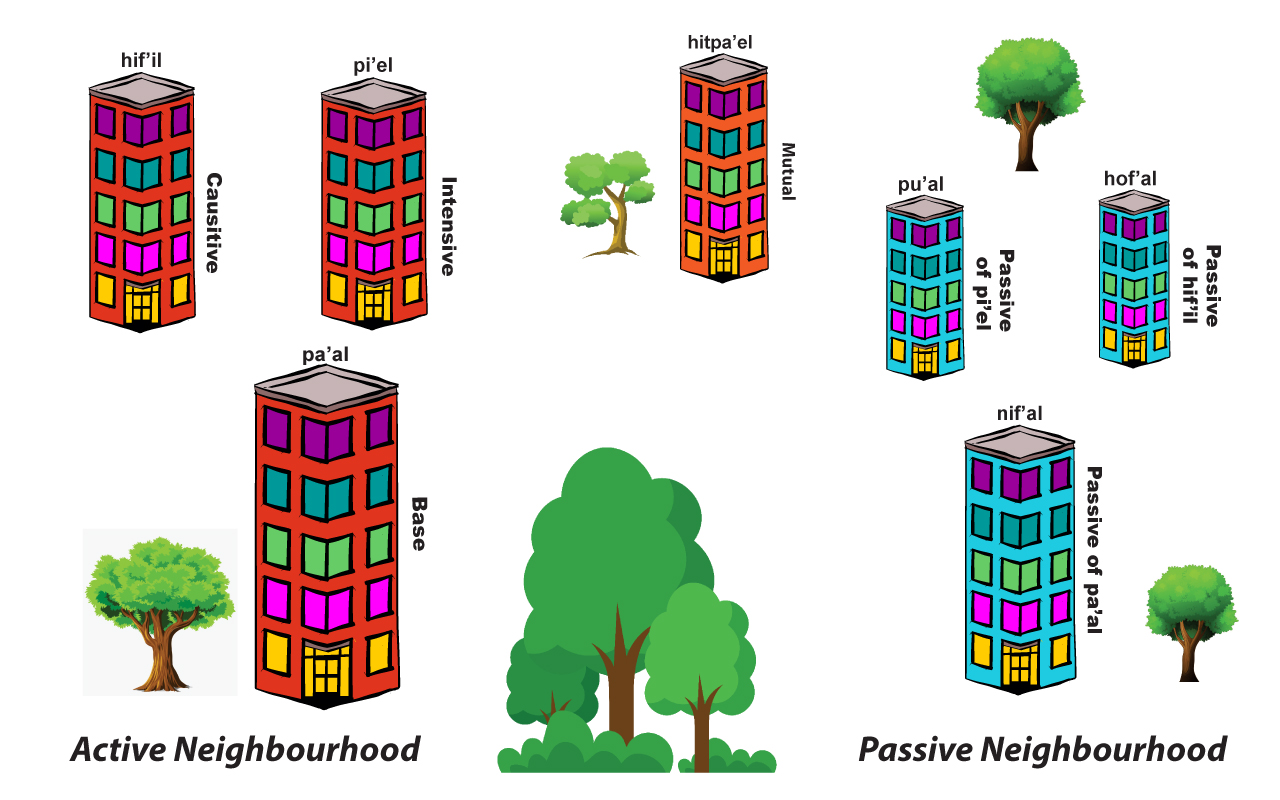
In Hebrew, a binyan is a building, a structure.
You can think of the Hebrew verb patterns as organized into a neighborhood of apartment buildings. All the buildings have the same floor plan, but with different theme décor.
In each building, there is a floor for each verb form: perfect, imperfect, narrative, commands, infinitives, and participles. On each floor, there are a number of suites – for roots with three strong letters, for roots that end in ה, for roots that begin with ע, with י, with נ, etc. Each suite is divided into rooms by gender, number, and person.
To navigate this page, click the rooftops to see each binyan, and click on the floors to see each conjugation.
pa'al perfect

Perfect verbs express the aspect of completeness. They are used in the Bible primarily to set the scene, to speak about something that happened before the narrative takes place. It is often appropriate to translate pa’al perfect verbs using the English pluperfect: It had happened, or It has happened.
The most distinctive use of perfect verbs is to speak of something that happened before the start of the current narrative. In this usage, it is often best translated using the English “pluperfect” – “it had happened,” “he has gone,” etc.
pa'al imperfect

Imperfect verbs express the aspect of ongoing-ness. In the Bible, imperfects are often used to express a hope or a vision—May it be that… in English, we might use “shall,” for example when giving instructions: The priest shall make a sacrifice…
The imperfect is only rarely used to tell a narrative in the future tense. Rather, it is often best translated as “let it be…,” “may it happen,” “it might be,” “[if] it should happen that…,” “it might happen.”
pa'al narrative

The biblical narrative form is the verb form that is used for telling stories in the Bible. It is similar in pattern to the imperfect, with an additional ו prefix. Historically, this form was probably distinct from the imperfect, but as it has evolved, the two forms—imperfect and narrative—are almost identical except for the addition of the narrative prefix. For this reason, biblical narrative verbs give the impression that stories are being told from inside the action. Sadly, these verbs must be translated using past tense in English, as no form approximates this continuous action.
Verbs in the biblical narrative form are the Bible's most prevalent. They always come at the beginning of a clause, never preceded by their subject or object. If the subject is clear from context, it is often left out.
pa'al participle

Hebrew participles act as nouns and adjectives. Like adjectives, they are conjugated by gender and number, but not by person.
pa’al infinitive construct

The infinitive construct is a noun describing the act of doing the verb, often with a preposition prefix and/or a possessive suffix. The idiomatic English “to do [something]” is paralleled in Hebrew using the preposition
Pa’al פָּעַל
This is the base on which the other binyanim are modeled. Verbs in binyan pa'al פָּעַל can be active or stative, transitive or intransitive.
Nif’al נִפְעַל
Verbs in binyan nif’al נִפְעַל express the core meaning of the root, usually with a passive or reflexive sense. For example, the root ז.כ.ר means “remember” in pa’al; it means “be remembered” in nif’al. The strongest characteristic of the binyan is the nun נ prefix, but when an additional prefix is required, as in the imperfect and narrative forms, that נ is disguised as a dagesh.
Hif’il הִפְעִיל
Verbs in binyan hif’il הִפְעִיל express the core meaning of the root, usually with a causative sense. For example, the root ז.כ.ר means “remember” in pa’al; in hif’il it means he caused [someone] to remember, he reminded [someone], he mentioned [something]. The strongest characteristic of the binyan is the hei ה prefix, but when an additional prefix is required, as in the imperfect and narrative forms, that ה is disguised as a patakh. The yud י between the second and third root letters also a strong characteristic, but it changes or disappears in a number of situations.
Pi’el פִּעֵל
Verbs in binyan pi’el פִּעֵל often express the core meaning of the root with a repetitive or intensive sense. For example, the root שׁ.ב.ר means “break [something]” in pa’al; in pi’el it means “smash it to bits.” Some roots commonly used in pi’el are rarely, if ever, found in pa’al, such as ד.ב.ר, meaning “speak.” The major characteristic of this binyan is a dagesh forte in the second root letter, doubling it and intensifying it. (Unfortunately, in the model root פּ.ע.ל the dagesh is impossible in the ע.)
Hitpa’el הִתְפַּעֵל
Binyan hitpa’el הִתְפַּעֵל produces reflexive or mutual verbs. For example, הִתְחַבֵּא means “he hid himself”; הִתְחַזֵּק means “he took courage.” The characteristic transformation is the prefix הִתְ and a dagesh forte in the second root letter (when possible).
Hof’al הָפְעַל
Binyan hof’al הָפְעַל is doubly derived: it transforms verbs from binyan hif’il into their passive sense. For example, in pa’al the root מ.ל.ך means “rule as king.” In hif’il, it has a causative sense, meaning “crown [someone] as king.” In hof’al, it means “become crowned [by someone].”
Pu’al פֻּעַל
Binyan pu’al פֻּעַל is doubly derived: it is transforms verbs from binyan pi’el into their passive sense. For example, in pi’el the root שׁ.ל.ח means “set free/send away”; in pu’al it means “be set free/sent away.” The root ד.ב.ר in pi’el means “be spoken.”
nif'al perfect

Perfect verbs express the aspect of completeness. They are used in the Bible primarily to set the scene and speak about something that happened before the narrative.
If a verb in pa’al means that the subject did something, its corresponding nif’al verb often means that something happened to the subject.
The most distinctive use of perfect verbs is to speak of something that happened before the start of the current narrative. In this usage, it is often best translated using the English “pluperfect” – “it had been built,” “had been done,” etc.
nif'al imperfect

Imperfect verbs express the aspect of ongoing-ness. In the Bible, imperfects are often used to express a hope or a vision—May it be that… in English, we might use “shall,” for example when giving instructions: The priest shall be seen…
The imperfect is only rarely used to tell a narrative in the future tense. Rather, it is often best translated as “let it be…,” “may it be remembered,” “it might be built up,” etc.
nif'al narrative
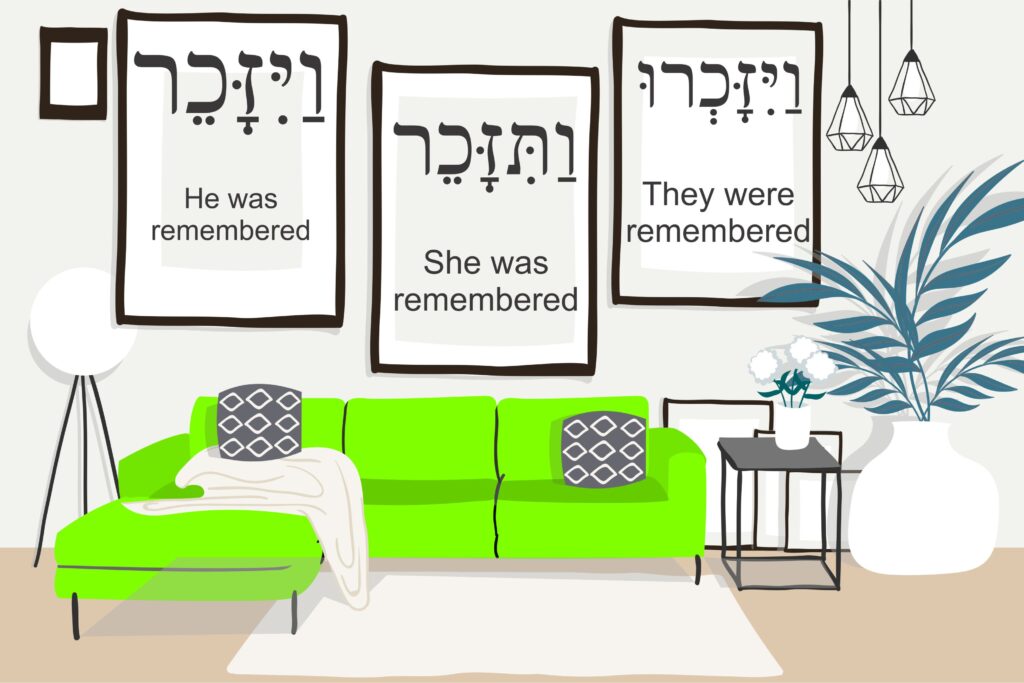
The biblical narrative form is the verb form that is used for telling stories in the Bible. It is similar in pattern to the imperfect, with an additional ו prefix. Historically, this form was probably distinct from the imperfect, but as it has evolved, the two forms—imperfect and narrative—are almost identical except for the addition of the narrative prefix. For this reason, biblical narrative verbs give the impression that stories are being told from inside the action. Sadly, these verbs must be translated using past tense in English, as no form approximates this continuous action.
Verbs in the biblical narrative form are the Bible's most prevalent. They always come at the beginning of a clause, never preceded by their subject or object. If the subject is clear from context, it is often left out.
nif'al participle

Hebrew participles act as nouns and adjectives. Like adjectives, they are conjugated by gender and number, but not by person.
nif'al infinitive construct

The infinitive construct is a noun describing the act of doing the verb, often with a preposition prefix and/or a possessive suffix. The idiomatic English “to do [something]” is paralleled in Hebrew using the preposition
hif'il perfect

Perfect verbs express the aspect of completeness. They are used in the Bible primarily to set the scene, to speak about something that happened before the narrative takes place.
Hif’il verbs generally express a meaning related to that of the pa’al, but with a causative sense. For example, “he remembered” in pa’al becomes in hif’il “he caused [someone] to remember” or “he reminded [someone]. Hif’il verbs are almost always transitive – they are about doing something to something.
The most distinctive use of perfect verbs is to speak of something that happened before the start of the current narrative. In this usage, it is often best translated using the English “pluperfect” – “he has caused something to stand”, “he has erected something”, etc.
Click for examples of common forms.
hif'il imperfect

Imperfect verbs express the aspect of ongoing-ness. In the Bible, imperfects are often used to express a hope or a vision—May it be that… in English, we might use “shall,” for example when giving instructions: The priest shall sanctify…
The imperfect is only rarely used to tell a narrative in the future tense. Rather, it is often best translated as “let it announce…,” “she shall dress someone,” “he shall sire,” “it can establish…,” “they shall remind”
hif'il narrative
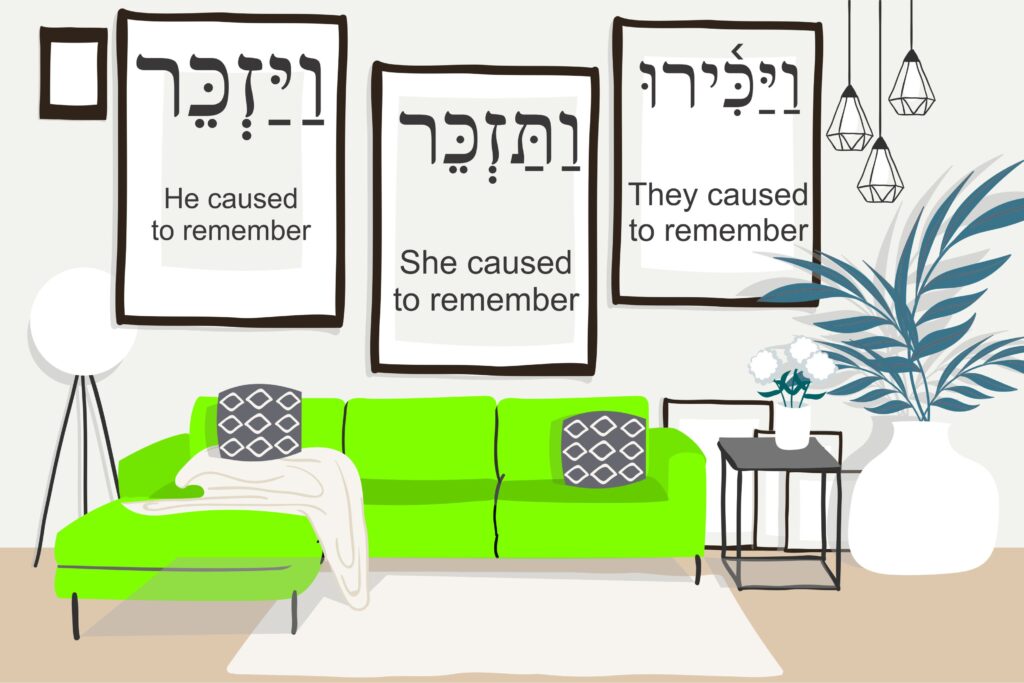
The biblical narrative form is the verb form that is used for telling stories in the Bible. It is similar in pattern to the imperfect, with an additional ו prefix. Historically, this form was probably distinct from the imperfect, but as it has evolved, the two forms—imperfect and narrative—are almost identical except for the addition of the narrative prefix. For this reason, biblical narrative verbs give the impression that stories are being told from inside the action. Sadly, these verbs must be translated using past tense in English, as no form approximates this continuous action.
Verbs in the biblical narrative form are the Bible's most prevalent. They always come at the beginning of a clause, never preceded by their subject or object. If the subject is clear from context, it is often left out.
Click for examples of common forms.
hif'il participle

Hebrew participles act as nouns and adjectives. Like adjectives, they are conjugated by gender and number, but not by person..
Hif’il verbs like all the binyanim except pa’al and nif’al, the participle form is built with a מ prefix. In all cases, the מ prefix is vocalized in the same way as the signal letter for the imperfect.
Click for examples of common forms.
hif'il infinitive construct

The infinitive construct is a noun describing the act of doing the verb, often with a preposition prefix and/or a possessive suffix. The idiomatic English “to do [something]” is paralleled in Hebrew using the preposition.
With the exception of the perfect form, the infinitive construct acts as a skeleton form that underlies all the hif’il conjugations with strong roots.
Click for examples of common forms.
pi'el perfect

Perfect verbs express the aspect of completeness. They are used in the Bible primarily to set the scene, to speak about something that happened before the narrative takes place.
The piel perfect verb is similar to pa’al perfect form though the meaning is intensified or (sometime) repeated. For example, in the pa’al שׁ.ב.ר means “break something”; in pi’el it means “smash it to bits.”
The most distinctive use of perfect verbs is to speak of something that happened before the start of the current narrative. In this usage, it is often best translated using the English “pluperfect” – “he has smashed something to pieces”, “shattered something”, etc.
pi'el imperfect
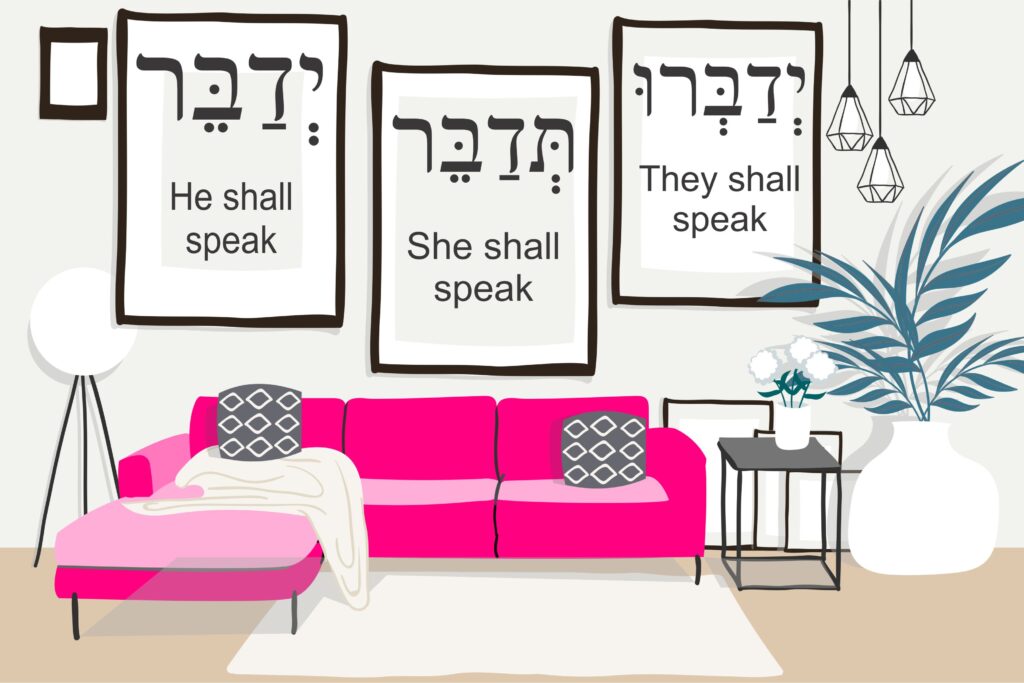
Imperfect verbs express the aspect of ongoing-ness. In the Bible, imperfects are often used to express a hope or a vision—May it be that… in English, we might use “shall,” for example when giving instructions: The priest shall sanctify…
The imperfect is only rarely used to tell a narrative in the future tense. Rather, it is often best translated as “let it praise…,” “he shall teach,” “he shall lift up,” “it can be counted…,” “he shall be set free.”
pi'el narrative
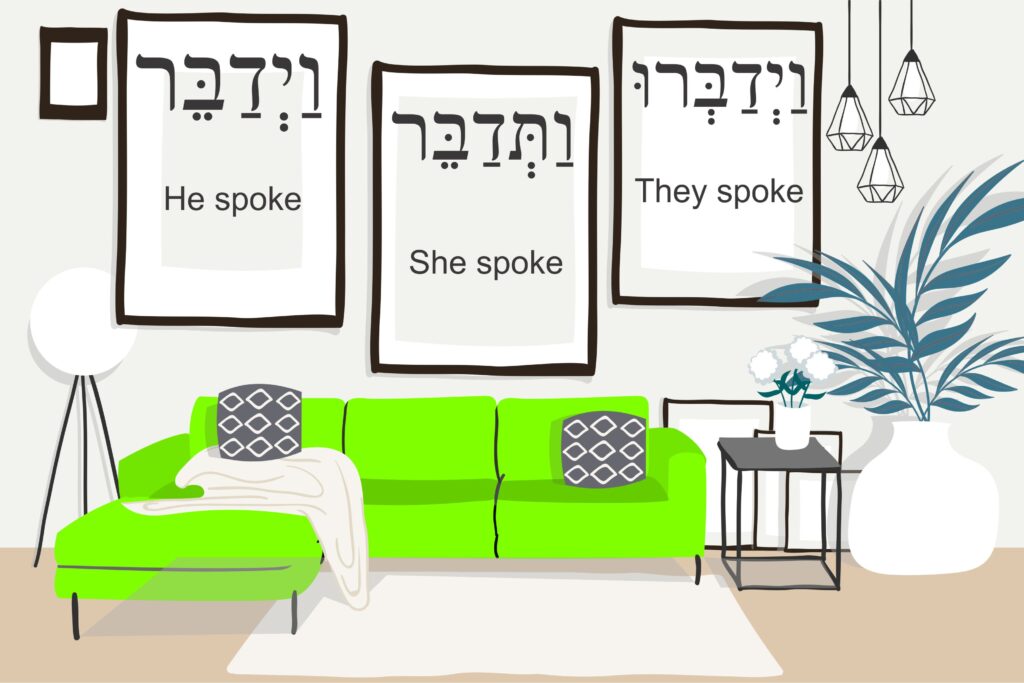
The biblical narrative form is the verb form that is used for telling stories in the Bible. It is similar in pattern to the imperfect, with an additional ו prefix. Historically, this form was probably distinct from the imperfect, but as it has evolved, the two forms—imperfect and narrative—are almost identical except for the addition of the narrative prefix. For this reason, biblical narrative verbs give the impression that stories are being told from inside the action. Sadly, these verbs must be translated using past tense in English, as no form approximates this continuous action.
Verbs in the biblical narrative form are the Bible's most prevalent. They always come at the beginning of a clause, never preceded by their subject or object. If the subject is clear from context, it is often left out.
pi'el participle
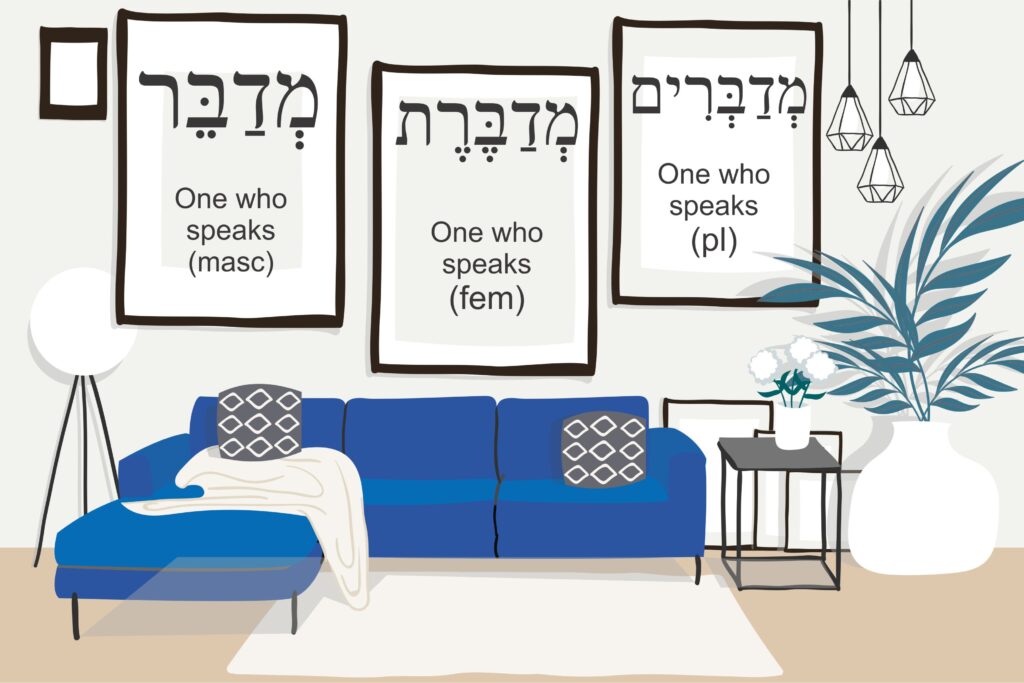
Hebrew participles act as nouns and adjectives. Like adjectives, they are conjugated by gender and number, but not by person.
Pi’el verbs like all the binyanim except pa’al and nif’al, has its participle form built with a מ prefix. In all cases, the מ prefix is vocalized in the same way as the signal letter for the imperfect.
pi'el infinitive construct

The infinitive construct is a noun describing the act of doing the verb, often with a preposition prefix and/or a possessive suffix. The idiomatic English “to do [something]” is paralleled in Hebrew using the preposition